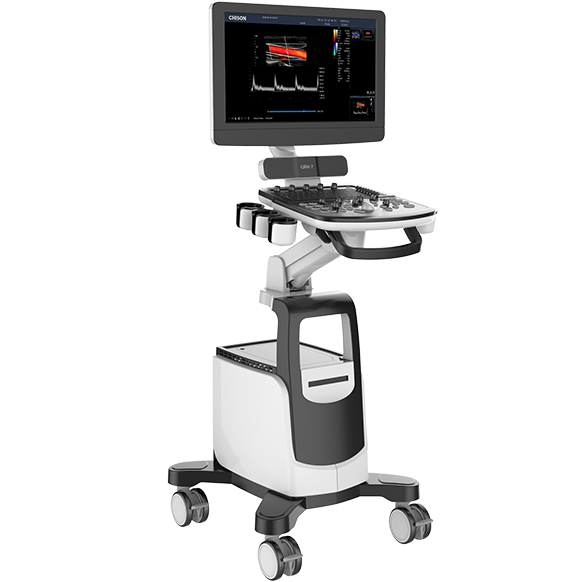
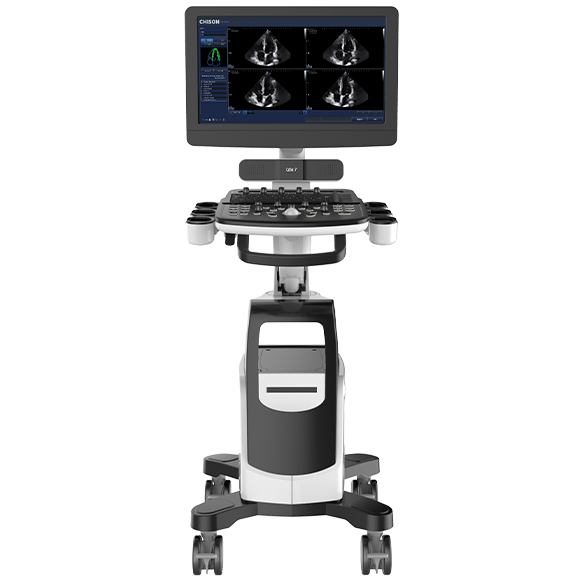
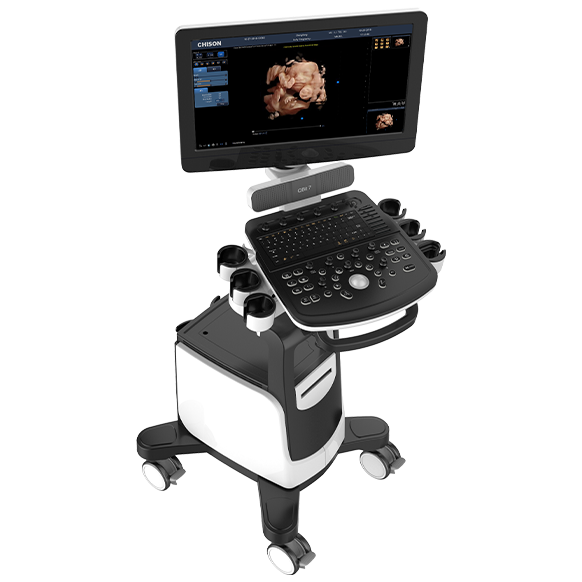
The QBit 7 is an innovative color doppler system with 4D technology and Virtual HD. Images are highly detailed and visually stunning and seen on a generous 19" LED screen. Diagnoses are readily made and reports are easy to generate. Exceptional for Cardiac, OB/Gyn and more with extensive software packages.
Professional Clinical Applications
- ABD
- OB / GYN
- Vascular
- MSK
- Small Parts
- Urology
- Pediatrics
- Cardiac
Image Processing Technologies
- Speckle Reduction Algorithm (SRA)
- Multiple Compound Imaging (MCI)
- Q-image
- Q-flow
- X-contrast
- Q-beam
- FHI
- Super Needle
Imaging Modes
- B, 2B, 4B, B/M, M
- CFM, B/BC
- PW/CW
- PD, Directional PD
- Duplex, Instant Triplex, Quadplex
- Trapezoidal Imaging
- Curved Panoramic Imaging (optional)
- 2D Steer (optional)
- Chroma B/M/PW/CW
- 4D (optional)
- Virtual HD/Depth View (optional)
- Steer M, Color M, TDI (optional)
- StressEcho (optional)
- Elastography available on 8 kinds of probes(optional)
- ECG (optional)
Advanced Technologies
Q-beam
- Compared to the traditional dual-beam former on most ultrasound machines, the QBit uses quad-beam technology for ultrasound signal receiving.
- Doubles the volume of signals received over traditional methods, increasing image resolution and generating more accurate images.
- Produces higher frame rates, ensuring better diagnostic conidence and fficiency, especially for moving organs.
FHI
- FHI is an innovative harmonic imaging technology that uses multiple transmission and receiving methods based on the patients' size and weight. This allows the QBit to maintain image resolution when imaging larger patients.
- Traditional Tissue Harmonics and Phased Harmonics compromise image quality and resolution when penetration is increased.
- Chison's FHI technology greatly improves diagnostic abilities and clinical confidence in larger, difficult-to-image patients.
X-contrast
- The QBit allows one-touch user-adjusted contrast resolution based upon differences in tissue density.
- Enhance, Normal, and Suppress settings increase or decrease contrast resolution, based on the tissue type and user preference.
Q-flow
- This adaptive color detection technology can automatically adjust the assessment of color signal and noise according to different tissues.
- As a result, color sensitivity of low velocity flow is significantly enhanced.